Vinyl and film
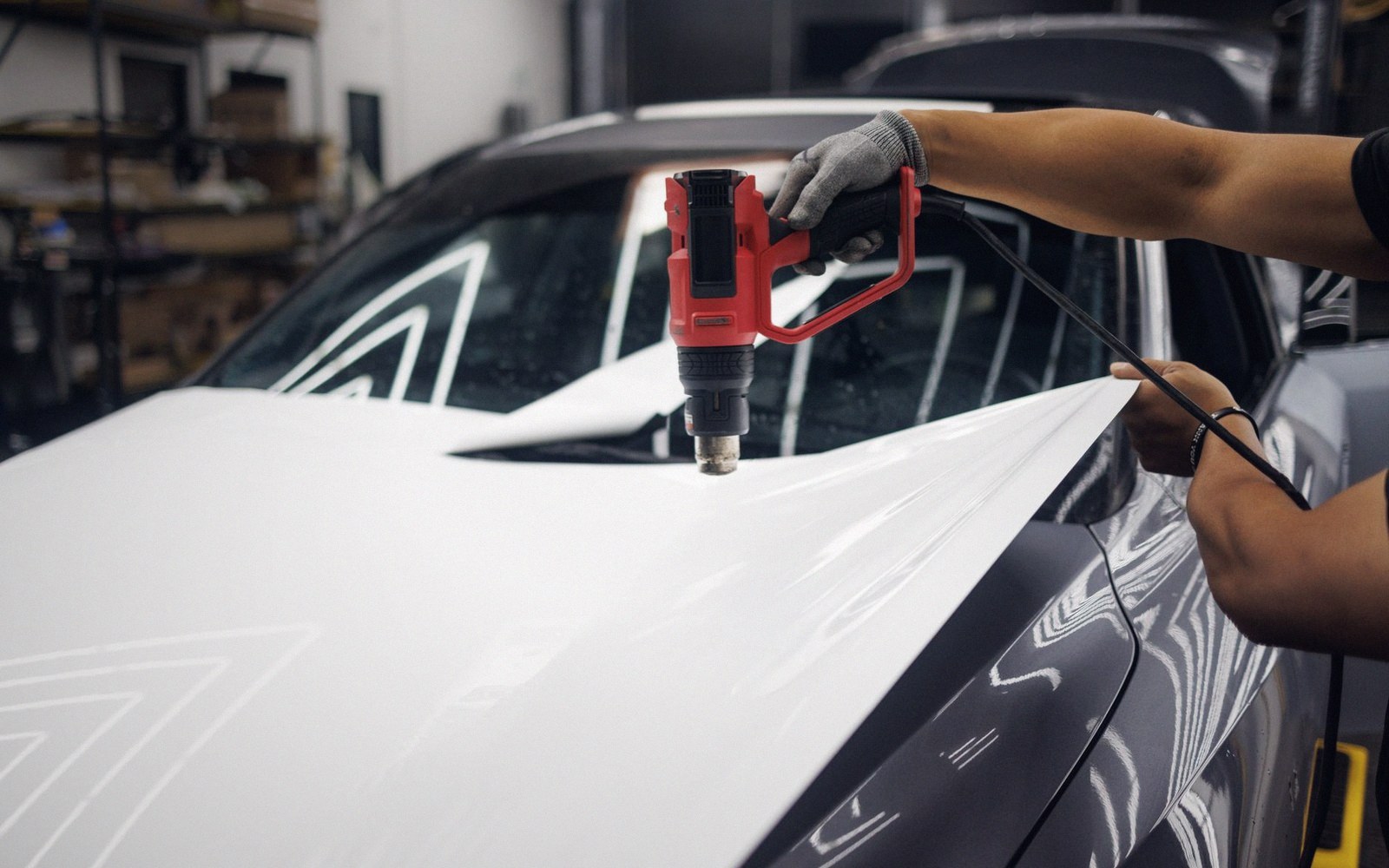
Wet or dry decides one thing: whether a bubble is still fixable ten minutes later.
Photo: Auto Records / PexelsThe application method is the decision
Pressure-sensitive vinyl arrives in two forms that behave completely differently on site, and mixing up the handling of each is how you get a stand that looks assembled by someone who has never done it before.
Cast vinyl — the thinner, more conformable grade — is the right call for any surface that curves, ribs or has shallow embossing. Calendered vinyl, stiffer and cheaper, lies flat under tension on flat panels but will telegraph every surface imperfection and will not persuade itself around a corner without lifting at the edge. Specifying calendered on a curved frame to save money is a false economy that shows from ten metres.
 Fig. 02
One pass, from the centre out, with the fluid still moving under the film.
The wetter the installation, the longer you have to reposition. Slip solution — water with a trace of washing-up liquid — slows the adhesive bond long enough for a two-person team to float a large panel into registration before squeegee-pressing it down from centre to edge. This is standard practice on anything above roughly one metre wide. Dry application is faster and more aggressive: the adhesive grabs on first contact, which means any misalignment has to be lifted before the bond cures fully, and lifting risks stretching the film and ruining the edge. For small-format cut lettering, dry is fine; for a full graphic panel, it is a gamble.
Bubbles are where the argument plays out. A bubble under wet-applied film, caught during the installation window, can be worked to the nearest edge with a squeegee. The same bubble under dry-applied film usually has to be needle-pierced, pressed flat and hoped for — and on a gloss laminate, the needle mark will catch the light. Gloss versus matte laminate choice is worth settling before print is ordered, because the finish changes not just the look but the risk profile of the whole application.
Air-egress films — sometimes called micro-perforated or dot-matrix films — sidestep some of this by providing a structured release path for trapped air, and they have become the sensible default for large direct-to-substrate prints. The penalty is a slight texture visible in raking light, which matters on a surface that will be lit from a tight angle.
Removal is the other half of the job. A film that was applied cold and held for four days pulls away cleanly. One that sat through a weekend under tungsten heat has usually bonded more tenaciously than the adhesive spec suggests, and a heat gun becomes a necessity rather than a convenience. Factoring in clean removal time during strike planning is not optional on a rental surface — leaving residue or tearing a panel finish is a damage charge that arrives weeks later.

Files are set to the bay width so that no panel needs trimming on site.