Cable runs

Routes are set before the deck goes down, because afterwards nothing can be moved.
Plan them before a single deck board goes down
Every cable in an exhibition stand eventually needs to arrive somewhere useful — a socket, a data port, a lighting controller, a monitor. Where it arrives is decided at the design stage. How it gets there is decided the morning the deck frame goes in. Miss that window and you are cutting inspection hatches in finished flooring while your neighbouring stand is already dressing.
The raised deck exists primarily to create a void — typically 100 mm to 150 mm of clear space between the hall floor and the finished surface. That void is the cable highway, and it is temporary. The moment decking panels are screwed down, the highway closes. This is why cable management and a raised deck are the same decision made at the same time, not sequential ones.
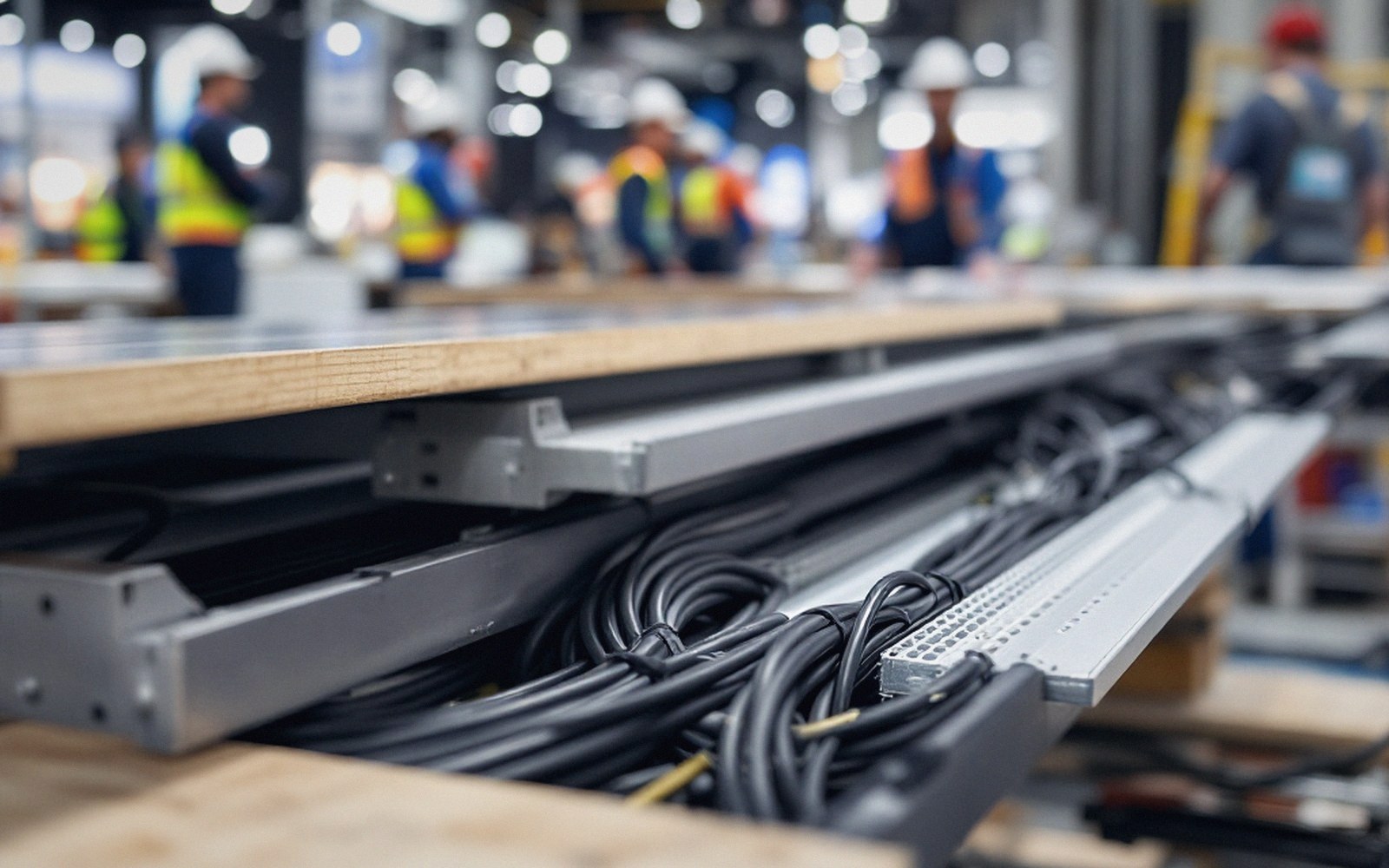 Fig. 02
Power, data and lighting kept apart in the void, each with slack coiled at its drop.
Zones, not individual runs
Route by zone first, individual cable second. Divide the stand into power, data, and AV, and give each a corridor through the void. Power and data want separation — ideally 150 mm or more — to avoid induced interference on signal lines, and they should cross at right angles rather than run parallel where the deck geometry allows it. Mark these corridors on the floor plan before fabrication, because the deck frame members will be placed to leave them clear. After the frame is down, moving a joist to open a run is a forty-minute job. Moving it before the frame is assembled is a two-minute conversation.
Egress points — where cables exit the deck to reach displays, counters or power points — must be cut or routed before panels go in. A clean cable exit is a grommeted hole or a routed channel; an unplanned one is a frayed hole hacked with a jigsaw on the show floor at midnight. Both get covered by carpet, but only one is safe, and neither the rigging crew nor the venue electrician will sign off on a stand where live cables abrade against raw timber edges.
Entry points from the venue power bay matter too. Know where the drop is before the deck frame goes down, because the cable must reach the void — usually through a fixed entry point at the stand perimeter — without creating a tripping edge.
Label everything before it disappears. A length of black flex in a dark void between load-in and opening day is indistinguishable from every other length of black flex. Sleeve colour, cable tags, and a simple numbering scheme on the as-built drawing take ten minutes to do right and two hours of frustration to reconstruct when someone needs to trace a fault on day two of the show.

The supply lands where the floor plan says, rarely where the stand wants it.
Photo: panumas nikhomkhai / Pexels