Colour and grade
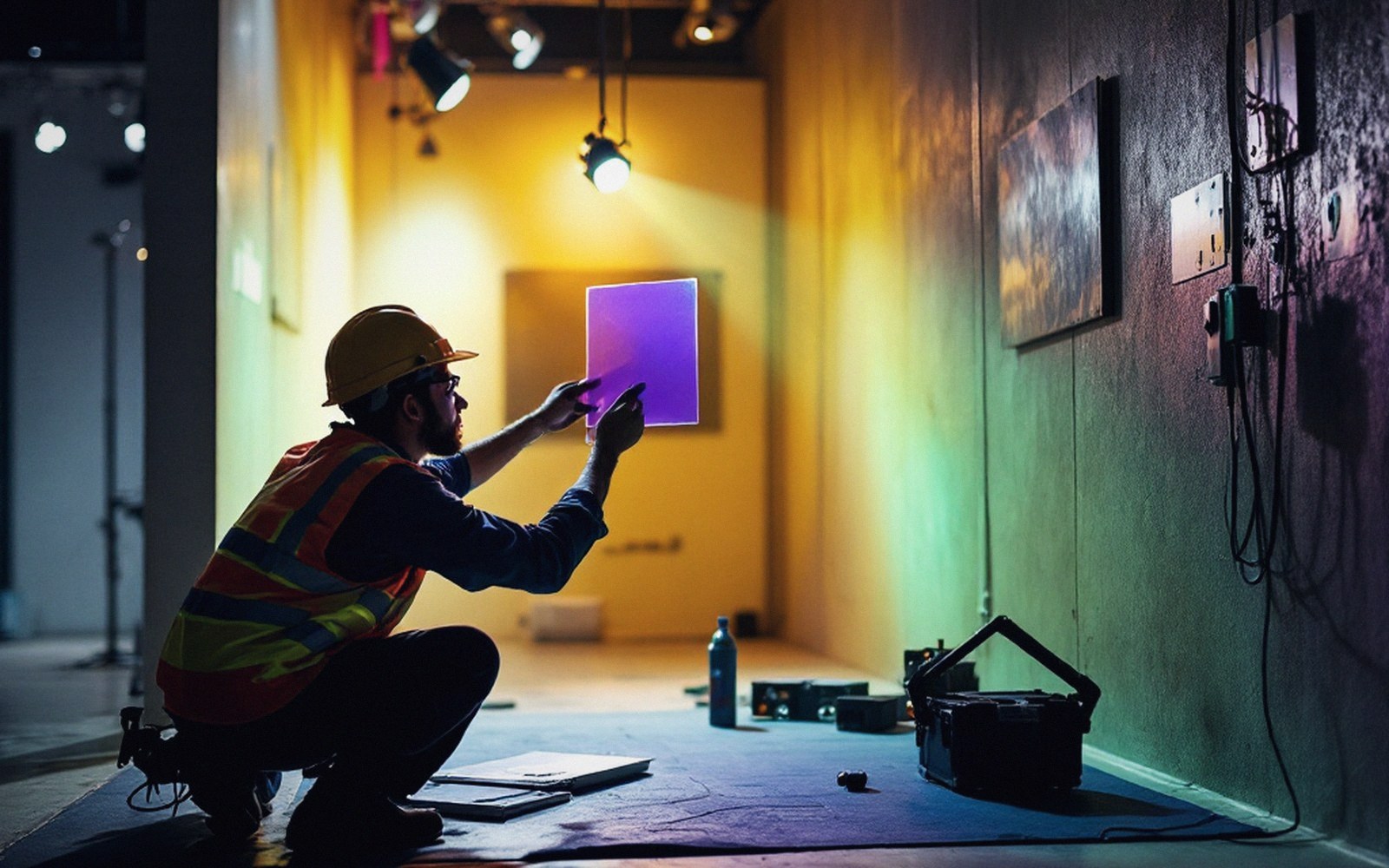
A sample approved under a studio lamp turns green under the hall’s own fittings.
Hall light is green, and everything you bring is corrected against it
Venue lighting is never neutral. Most exhibition halls run metal-halide or older fluorescent sources that sit somewhere between 3,800 K and 4,500 K with a green-magenta bias that puts a sallow cast on skin, shifts printed whites toward yellow, and turns carefully chosen fabric samples into something their designer wouldn't recognise. Your LED fixtures, your backlit graphics, your product lighting — all of them enter that ambient field the moment power comes on.
The first correction is colour temperature. Working at 4,000 K matches the hall and disappears into it; working at 3,000 K reads warm but competes poorly with cool ambient spill from the aisles; working at 5,600 K or above gives clean, daylight-accurate rendering but can look clinical unless the rest of the stand is designed to carry it. Most experienced stand lighting designers land between 3,500 K and 4,200 K and then manage contrast rather than fighting the room.
Paint can be corrected on site; laminate arrives as it will stay.
Photo: Nishant Aneja / PexelsThe second correction is the green channel. Consumer LED fixtures are often binned loosely and carry a mild green push. In a domestic room nobody notices. On a stand, that green lands on the faces of the people trying to close a sale, and it shows. Specifying fixtures by CRI alone is not enough: ask for the Duv figure, the deviation from the black-body curve. Fixtures with a Duv closer to zero — or very slightly below it, into the rose side — read clean under hall conditions. Anything consistently above +0.006 Duv will fight you all week.
Print complicates this further. A graphic colour-managed for a standard D50 viewing condition will not look the same under a 4,200 K source with a green bias. The correction belongs in the artwork production process, not on site — which is why colour proofing under show conditions is a real workflow step, not a nicety. Backlit graphics need a separate proof pass entirely, because the transmissive substrate shifts the colour balance again.
Gelling physical fixtures is still done — a quarter minus-green gel takes the edge off a metal-halide wash on a product table — but gel degrades with heat and the session work needed to get it right eats time that hall schedules rarely provide. Specifying the right fixture is the better solution; gelling is the field correction.
The discipline, at its simplest, is this: grade the stand's light as a film colourist grades a shot. Know what the ambient field is. Know where your sources sit relative to it. Decide whether you are matching the room or deliberately separating from it, and make that a choice rather than a surprise.

The grade is agreed with the sample and the fitting in the same hand.