
Contrast, not brightness: the product reads because the ground behind it does not.
The hall is already lit
Exhibition halls run at roughly 300–400 lux across the floor — enough to read by, enough to walk safely, and exactly enough to flatten everything. When every surface in a hall receives the same ambient wash, nothing stands out. A stand that simply adds more of the same light solves the wrong problem.
The instinct to go brighter is understandable and almost always wrong. Brightness is relative: pile on enough fixture lumens and the eye adjusts, the stand normalises against its neighbours, and you are back where you started — but with a hotter electricity draw and a higher rigging bill. What the eye actually responds to at ten metres is contrast: a dark background that makes a lit product snap forward, a beam angle tight enough to leave a visible shadow at the edge of the object, a surface that does not send ambient light straight back into the aisle.
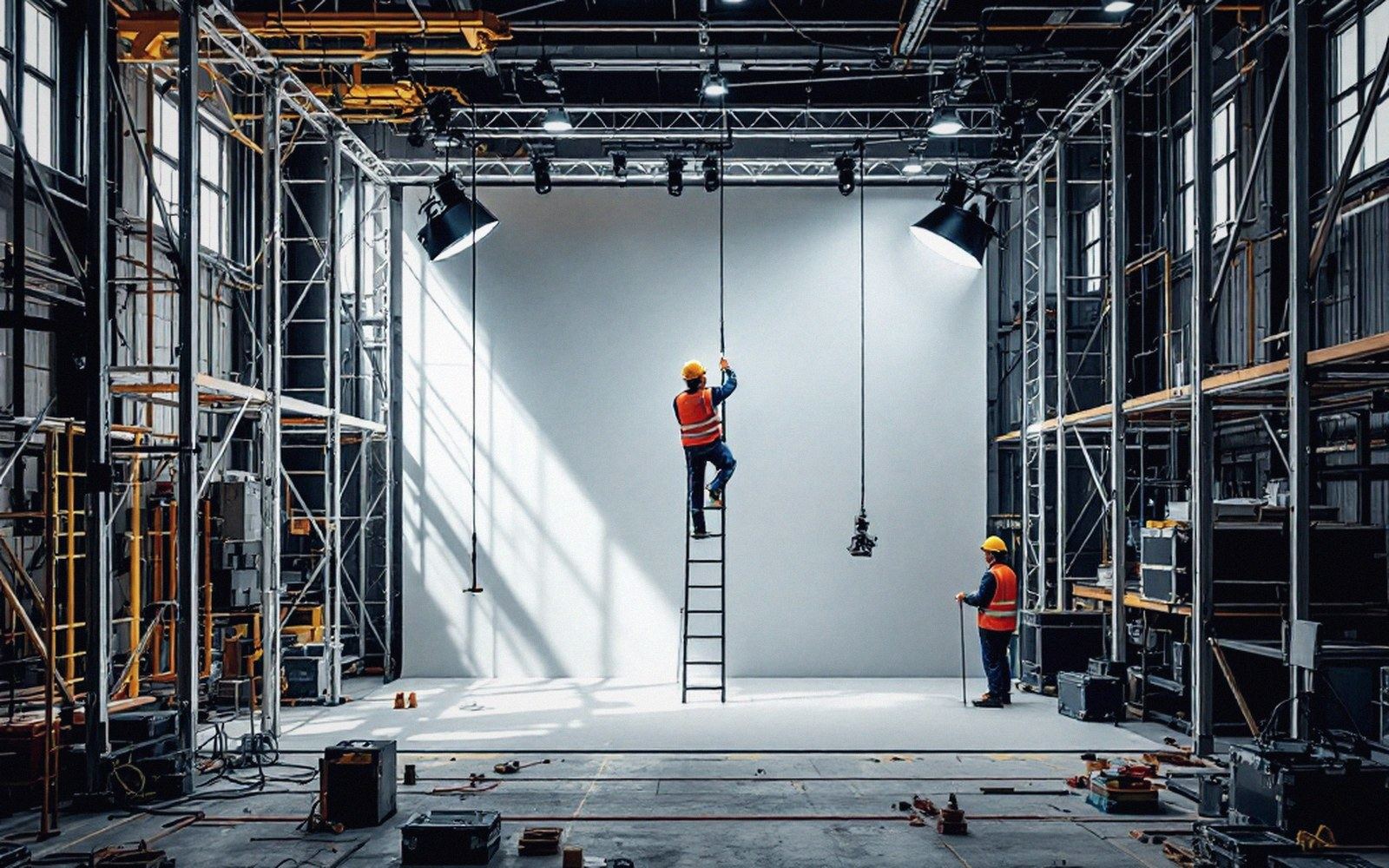 Fig. 02
Aiming happens with the hall lights down, before the ambient wash flattens everything by a fifth.
The operative metric is not lux but contrast ratio — the luminance difference between the illuminated subject and the field around it. An object needs a ratio of roughly 3:1 against its immediate surround to separate clearly at conversational distance. At ten metres, across a busy aisle with competing light sources on three sides, you want closer to 5:1 or more. You cannot achieve that by raising the floor plane; you achieve it by controlling what the background does.
Dark ground, lit object
The practical consequence is a counter-intuitive sequence of decisions. Choose the background before choosing the fixture. A deep-toned back wall — graphite, forest, navy — absorbs ambient hall light instead of reflecting it, giving you the dark field against which contrast becomes possible. A white or pale back wall reflects everything indiscriminately; your carefully aimed spots compete with the hall's own wash bouncing back at the visitor. The colour and grade correction you apply to your print surfaces compounds this — hall fluorescents and LED arrays both carry a green bias, and the cooler your background, the more you fight that cast rather than burying it.
Once the field is controlled, the fixture type and beam angle can do their job. Track-mounted LED spots, adjustable to a narrow beam — 15–24° at the widest for product work — concentrate photons on a small area and leave the surround comparatively dark. Ellipsoidal profiles (known in theatre as Lekos, though the term is used loosely in exhibition contexts) give hard-edged cut-off, which is occasionally worth the added bulk. Wash fixtures set to flood have almost no role in product lighting; they are useful for illuminating copy, faces, or a backlit graphic, not for making an object read from across an aisle.
Layering matters. An accent beam defines the product; a low-level fill — much dimmer, aimed at the floor or a plinth — keeps the surrounding volume readable without collapsing the contrast. The ratio between these two sources is the dial you tune on site, because what works in a model on a screen does not survive contact with the real hall. Arrive with the ability to adjust: dimmable circuits, adjustable fixtures, and at least an hour of lighting time before the doors open.
What you can control from the aisle
The ten-metre test is a useful discipline because it forces you to separate what looks good close up from what reads from a distance. Texture, finish quality, and typographic detail all collapse at ten metres. Silhouette, contrast, and colour temperature are what remain.
Run the test physically if you can — stand in the aisle during a quiet moment, look back, and ask whether the product is the brightest thing in the frame. If the frame itself is brighter, something about the background or the beam control needs to change. No amount of print resolution or finish quality compensates for an object that disappears into its own stand.
An object needs a ratio of roughly 3:1 against its immediate surround to separate clearly at conversational distance.
The job of exhibition lighting is not to illuminate a stand. It is to make one specific thing impossible to ignore.
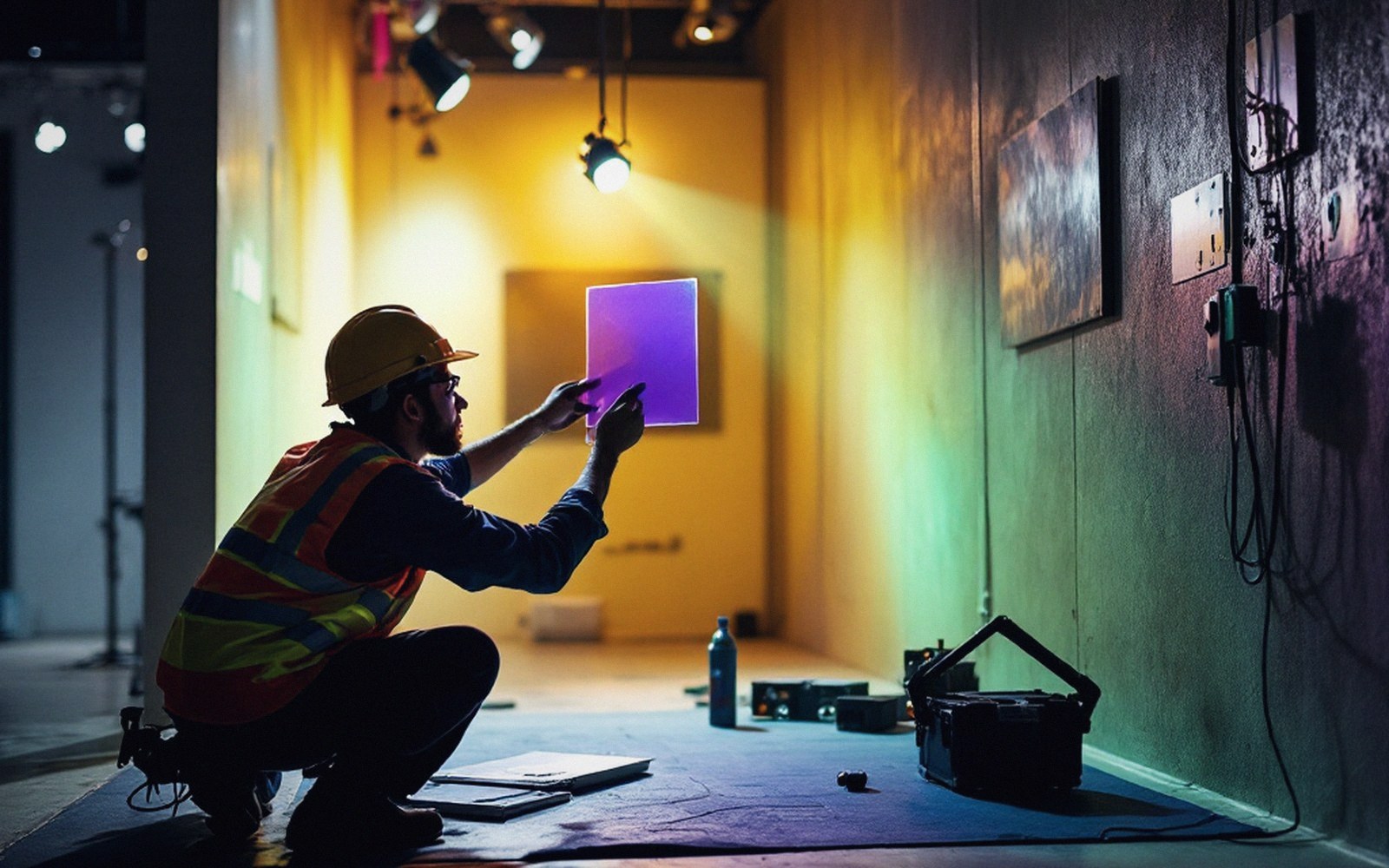
Hall light runs green; the finish is corrected against the fitting that will actually be above it.